
Reading Portfolio
Philosophy of Literacy
Introduction
In fall of 2019, I participated in the course, Education 741: Improvement in Reading. We were given the opportunity to write about our philosophy of literacy while focusing on the six T's of effective literacy instruction, which are: time, texts, teaching, talk, tasks, and testing.
Wisconsin Teaching Standards:
Standard 1: Pupil Development
Standard 4: Content Knowledge
Standard 8: Instructional Strategies
IRA Standards:
Standard 1: Foundational Knowledge
Standard 5: Learners and the Literacy Environment
Link to Standards Page for Additional Information and Descriptions About these Standards
Reflection
To be the best educator and reading teacher, it is important that I am self aware about my literacy beliefs and actions while considering effective and best practices to benefit my students. Writing my philosophy of literacy allowed me to reflect on my teaching practices and enabled me make adjustments to my teaching to ensure I am genuinely incorporating each of the six T's into my classroom on a daily basis.
I believe it is of the utmost importance that teachers allocate a large portion of the school day with students to reading and writing. According to Richard Allington, students should be reading and writing for at least half of the school day. Something that I have been focusing on in my classroom is keeping my minilesson short by engaging students in a read aloud where I use a mentor text that will support our lesson’s skill or strategy. During my read aloud or after my read aloud (depending on that day’s lesson), I model a specific strategy for students and think aloud. Some days we will add to one of our anchor charts, start a new anchor chart, or add to our minilesson section of our reader’s notebooks so students have a resource they can use during their own reading time.
After I model for my students, I give them a chance to practice the skill with a partner, and then I provide my students with the majority of our reading block to actually read and practice the skill or strategy from our daily minilesson. “Extensive reading is critical to the development of reading proficiency. Extensive practice provides the opportunity for students to consolidate the skills and strategies teachers often work so hard to develop” (Allington, 2002, p. 742). Incorporated into this is also giving my students time to write about their reading within their reader’s notebooks. While my students read in their just right reading books, I confer with students one on one and meet with students in small reading groups or strategy groups. Through using this reading workshop model, I am able to provide my students with more individual instruction and meet their literacy needs to help each student grow as a reader.
Time & Teaching

My fourth grade students reading during our reading workshop time.
I think it is essential to have large amounts of texts in my fourth grade classroom available to my students so they can find a book they are interested in reading time and time again. This is how we are going to cultivate a love of reading for our students. If we want our students to be reading throughout the majority of their school day, we need to have a variety of texts that are of various genres and levels available to our students. “It’s difficult for students to spend lots of time reading if they can’t easily find interest materials. Since we know that the amount of reading students do positively impacts their achievement, it makes perfect sense for the classroom library to be the cornerstone of the literacy classroom” (Routman, 2003, p. 66). In addition to having plenty of texts available for students, we must teach our students how to pick books that are truly just right for them. “Making sure that students are comprehending and enjoying the texts they are reading is critical for students’ reading success. A carefully monitored independent reading program as part of your reading workshop, total reading program, or literacy block is not an option. It is an absolute necessity. And having students spend most of their independent reading time with “just-right” books is a necessity, too, if students are to grow as readers” (Routman, 2003, p. 94)
Texts


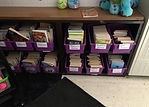
Some of the shelves in my classroom library.
In my opinion, giving students the opportunity to interact with their texts through talking with their peers is crucial to students’ engagement and growth in literacy. Giving students the opportunity to talk with a partner or discussing an aspect of the text as a class, allows students to think deeply about their interpretations and the thoughts of their peers, which helps them to better understand a text. In my fourth grade classroom, my students enjoy discussing our read aloud texts and it is one of their favorite parts of the day. Even my students that are more shy or that are struggling readers will participate in sharing their ideas and connections with a text we are reading as a group. “Reading partnerships and books clubs, in which students read and talk about a common book, play an important role in the reading workshop. Allowing time for students to talk helps them rehearse and revise their ideas about books, practice with peers some behaviors they will use when reading independently, and develop communities around common texts. When children talk, their thinking becomes visible”(Serravallo, 2018, p. 242).
Talk

My fourth graders talking with their classmates about the books they are reading.


It is of high importance to me that the tasks I ask my students to engage in with their reading, are meaningful and are tasks that will increase and deepen student understanding. When possible, I believe it is important that our reading tasks can connect to concepts from multiple content areas such as, writing, science, and social studies. I do believe that it is important to have my students write about their reading so they can expand upon their thoughts each idea and so that they remember various aspects of the texts they felt were important. Besides writing about reading, I feel it is beneficial for students to participate in tasks that are longer to show more in depth thinking rather than just short daily tasks (Allington, 2002). “The literacy tasks we ask students to do impacts their motivation for learning and their views of literacy. Authentic reading and writing in which students have some challenge, choice, control, and opportunity to collaborate motivate students most” (Routman, 2003, p. 204). When creating a task for my students to participate in, I always put myself in their shoes and think about if it is something I would have wanted to do as a kid or even if it something I would be interested in completing as an adult.
Tasks

One of my fourth graders writing about his reading.
The final aspect of the effective literacy practices is assessment. One way that I feel I get an accurate idea of where my students are at with their reading and writing and how they have improved during a period of time is through conferring with my students. While conferring with students, I am able to see which literacy skills students are becoming more proficient with and what skills and strategies students could use more teaching and practice with. I am also able to assess my students through formal and informal running records, through looking at the tasks that students complete, listening to conversations students have about their reading, reading my students writing about reading, and through my observations while meeting with students in small reading groups. Using assessment to drive our literacy instruction is what will help our students grow. I strongly believe that we cannot just look at one specific assessment or assessment type to determine what a student’s reading strengths and needs are. The purpose and ultimate advantage of completing a variety of assessment types with students in multiple settings is that we are able to get a better picture of that student as a reader. “As long as we are using the information we receive from student assessment, having students participate in multiple forms of assessment is well worth both the teacher and student’s time” (Valencia & Riddle Buly, 2004, p. 528).
Testing

Two forms of reading assessments, I complete with my students.

Resources
Allington, R. L. (2002). What Ive Learned about Effective Reading Instruction. Phi Delta Kappan, 83(10), 740–747.
Routman, R. (2003). Reading essentials: the specifics you need to teach reading well. Portsmouth, NH: Heinemann.
Serravallo, J. (2018). Understanding Texts & Readers: Responsive Comprehension Instruction with Leveled Texts. Portsmouth, NH: Heinemann.
Valencia, S. W., & Riddle Buly, M. (2004). Behind Test Scores: What Struggling Readers Really Need. The Reading Teacher,57(6), 520-531.